Asteroid 44 Nysa was moving slowly through the constellation Taurus on January 23rd. During the early evening hours, it was high in the sky. I caught it as it transited the celestial meridian at its highest point above the Oklahoma City light dome to the south.
Asteroid 44 Nysa on January 23, 2022. This 40-minute animation shows very little movement as the asteroid crawls ever so slowly northward through the constellation Taurus. Field of view is approximately 20×15 arcminutes. North is up. East is left. [1]On this evening, as the animation above shows, 44 Nysa’s apparent sky motion was very slow, moving only 0.14 arcseconds per minute. At the time of this imaging session, 44 Nysa was 1.317 AU (197,020,396 km/122,422,798 miles) from Earth. Its predicted V magnitude was 10.2, but measurements made on my images gave a magnitude of 11.0.
44 Nysa is a main belt asteroid whose orbit lies between the orbits of Jupiter and Mars. It is a relatively large object with a diameter of approximately 70 km (44 miles).
Notes:
1. January 23, 2022 02:46:54-03:26:47 UT. 14 images (6 x 30 sec). Telescope: Meade SN-8 (203 mm f/4 Schmidt-Newtonian). Camera: ZWO ASI224MC with UV/IR Cut Filter.
In late January, Comet 104P/Kowal was high in the western sky during early evening. I was able to capture images of it on January 23rd and 29th.
Comet 104P/Kowal January 23, 2022. Field of view 17×13 arcminutes (cropped from original 20.7×15.5 arcminutes). North is up. East is left. [1]On January 23rd (above), 104P/Kowal was moving briskly at 3.03 arcseconds per minute. Because I was not guiding on the comet, this movement limited exposures to a maximum of 60 seconds to avoid trailing of the comet’s image. The comet’s magnitude measured in the green channel was 12.77. There is no tail apparent in these images, although there is a hint of a very short tail pointing to the northeast (upper left).
Comet 104P/Kowal January 29, 2022. Field of view approximately 20×15 arcminutes. North is up. East is left. [2]By January 29th (above), 104P/Kowal had faded considerably. It’s magnitude measured in the green channel was 14.53. But, it was still moving quite rapidly as shown in the animation below.
Comet 104P/Kowal January 29, 2022. Twenty minute animation sequence. Field of view 15.6×11.2 arcminutes (cropped from original 20.7×15.5 arcminutes). North is up. East is left. [3]In this animation, 104P/Kowal is moving quickly along a northeasterly path at 3.17 arcseconds per minute. With a faint suggestion of a tail pointing to the northeast, the comet appears to be moving backwards, or chasing its tail.
Notes:
1. Comet 104P/Kowal January 23, 2022 01:52:14-02:26:25 UT. 16 x 60seconds. Telescope: Meade SN-8 (203 mm f/4 Schmidt-Newtonian). Camera: ZWO ASI224MC with UV/IR Cut Filter.
2. Comet 104P/Kowal January 29, 2022 03:31:24-03:51:06 UT. 19 (2 x 60seconds). Telescope: Meade SN-8 (203 mm f/4 Schmidt-Newtonian). Camera: ZWO ASI224MC with UV/IR Cut Filter.
3. Comet 104P/Kowal January 29, 2022 03:31:24-03:51:06 UT. Twenty minute animation sequence. 19 images (2 x 60 seconds). Telescope: Meade SN-8 (203 mm f/4 Schmidt-Newtonian). Camera: ZWO ASI224MC with UV/IR Cut Filter.
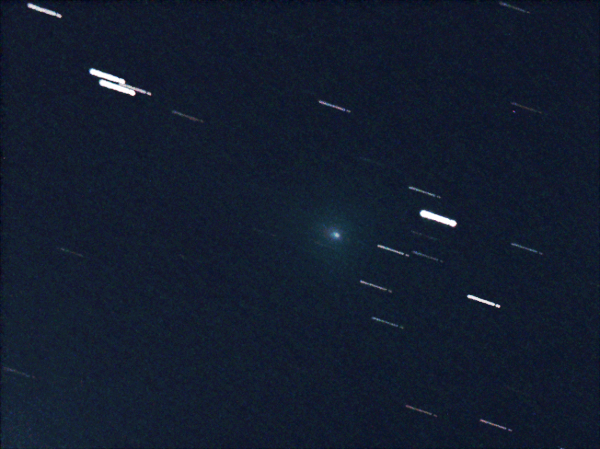
I’m still processing images from last month’s imaging sessions and am finally getting around to Comet 67P/Churyumov-Gerasimenko images captured on January 23rd. Although Comet 67P passed perihelion in November, it was, and as of this writing still is, well placed for viewing in the evening sky.
This image of 67P consists of seven 240-second images stacked to produce a single image. Field of view 20×15 arcminutes. North is up. East is left.[1]
67P moves across the sky over a 24-minute period. On this night, 67P was moving westward at 0.5 arcseconds per minute, or approximately one-half an arcminute per hour. Field of view 20×15 arcminutes. North is up. East is left.[2]
On images captured during this session, I measured 67P’s magnitude as 12.25. By this time, the comet had faded considerably from its peak near magnitude 8.0 in November when it passed perihelion. In these images you can see a faint tail extending approximately 8 arcminutes to the west-northwest (north is up and west is to the right).
If you click on either of the two images, the larger image that appears in your browser may show dark artifacts in the upper left corner, lower left corner, and along the left edge of the image. You also may notice a faint bright glow in the upper right corner. Unfortunately, the dark frames I captured this session for calibrating my images were not done correctly. Thus, the ugly artifacts. Plain old operator error.
Notes:
1. January 23, 2022, 03:51:45-04:15:52 UT. Stack of seven images, each a stack of 2 frames at 120 seconds (total 240 seconds). Gain: 250. Telescope: Meade SN-8 (203mm f/4). Camera: ZWO ASI224MC with UV/IR cut filter. Mount: Celestron CGEM.
2. January 23, 2022, 03:51:45-04:15:52 UT. 24-minute, 7-image, animation sequence. Each image a stack of 2 frames at 120 seconds each (total 240 seconds). Gain: 250. Telescope: Meade SN-8 (203mm f/4). Camera: ZWO ASI224MC with UV/IR cut filter. Mount: Celestron CGEM.