
 AstroNotes is migrating to a new format. Please bear with us as we complete this upgrade.
Hopefully the place will be fixed up by mid-May 2024.
AstroNotes is migrating to a new format. Please bear with us as we complete this upgrade.
Hopefully the place will be fixed up by mid-May 2024.
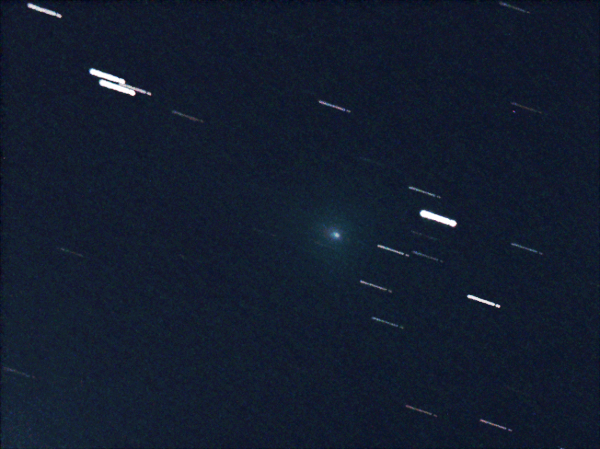
In late January, Comet 104P/Kowal was high in the western sky during early evening. I was able to capture images of it on January 23rd and 29th.


Notes:
1. Comet 104P/Kowal January 23, 2022 01:52:14-02:26:25 UT. 16 x 60seconds. Telescope: Meade SN-8 (203 mm f/4 Schmidt-Newtonian). Camera: ZWO ASI224MC with UV/IR Cut Filter.
2. Comet 104P/Kowal January 29, 2022 03:31:24-03:51:06 UT. 19 (2 x 60seconds). Telescope: Meade SN-8 (203 mm f/4 Schmidt-Newtonian). Camera: ZWO ASI224MC with UV/IR Cut Filter.
3. Comet 104P/Kowal January 29, 2022 03:31:24-03:51:06 UT. Twenty minute animation sequence. 19 images (2 x 60 seconds). Telescope: Meade SN-8 (203 mm f/4 Schmidt-Newtonian). Camera: ZWO ASI224MC with UV/IR Cut Filter.
I’m still processing images from last month’s imaging sessions and am finally getting around to Comet 67P/Churyumov-Gerasimenko images captured on January 23rd. Although Comet 67P passed perihelion in November, it was, and as of this writing still is, well placed for viewing in the evening sky.
 |
 |
| This image of 67P consists of seven 240-second images stacked to produce a single image. Field of view 20×15 arcminutes. North is up. East is left.[1] | 67P moves across the sky over a 24-minute period. On this night, 67P was moving westward at 0.5 arcseconds per minute, or approximately one-half an arcminute per hour. Field of view 20×15 arcminutes. North is up. East is left.[2] |
On images captured during this session, I measured 67P’s magnitude as 12.25. By this time, the comet had faded considerably from its peak near magnitude 8.0 in November when it passed perihelion. In these images you can see a faint tail extending approximately 8 arcminutes to the west-northwest (north is up and west is to the right).
If you click on either of the two images, the larger image that appears in your browser may show dark artifacts in the upper left corner, lower left corner, and along the left edge of the image. You also may notice a faint bright glow in the upper right corner. Unfortunately, the dark frames I captured this session for calibrating my images were not done correctly. Thus, the ugly artifacts. Plain old operator error.
Notes:
1. January 23, 2022, 03:51:45-04:15:52 UT. Stack of seven images, each a stack of 2 frames at 120 seconds (total 240 seconds). Gain: 250. Telescope: Meade SN-8 (203mm f/4). Camera: ZWO ASI224MC with UV/IR cut filter. Mount: Celestron CGEM.
2. January 23, 2022, 03:51:45-04:15:52 UT. 24-minute, 7-image, animation sequence. Each image a stack of 2 frames at 120 seconds each (total 240 seconds). Gain: 250. Telescope: Meade SN-8 (203mm f/4). Camera: ZWO ASI224MC with UV/IR cut filter. Mount: Celestron CGEM.
I was processing and analyzing some images of Comet 67P/Churyumov-Gerasimenko from a January 29th imaging session when the program I was using (Astrometrica) alerted me to the fact that there were two known, but faint, asteroids in the same field of view. This was a real bonus!

Astrometrica detected these two small main belt asteroids barely above the noise level. There was just enough signal, however, to measure their magnitudes. Asteroid 33651 was measured at magnitude 17.0 and asteroid 103516 as magnitude 17.3. JPL’s online Horizons System predicted magnitudes for 33651 as 17.3 and 103516 as 17.0. Comet 67P’s magnitude was measured as 12.5.
I was pretty surprised by the detections of these two asteroids. I image from a heavily light polluted backyard under Bortle 7-8 skies. These two objects were quite faint, and the images were only 30-second exposures.
Neither the JPL’s Small-Body Database, nor the Lowell Observatory’s Asteroid Information Database give sizes for these objects. But, both databases gave absolute magnitudes (H) for them: 14.6 for asteroid 103516, and 13.5 for asteroid 33651. According to the JPL’s Asteroid Size Estimator, objects with these absolute magnitudes should have diameters in the range of 3-12 km (2-8 miles).
At the time of this imaging session, Asteroid 103516 was 174 million km (108 million miles) from Earth and asteroid 33651 was 263 million km (163 million miles) distant.
All things considered, I am amazed that my small backyard observing rig detected both of these tiny chunks of rock that were well beyond the orbit of Mars.
Notes:
1. January 29, 2022, 06:28:19-06:58:36 UT. Stack of three images, each a stack of 4 frames at 30 seconds (total 120s). Gain: 250. Telescope: Meade SN-8 (203mm f/4). Camera: ZWO ASI224MC with UV/IR cut filter. Mount: Celestron CGEM.