I was processing and analyzing some images of Comet 67P/Churyumov-Gerasimenko from a  January 29th imaging session when the program I was using (Astrometrica) alerted me to the fact that there were two known, but faint, asteroids in the same field of view. This was a real bonus!

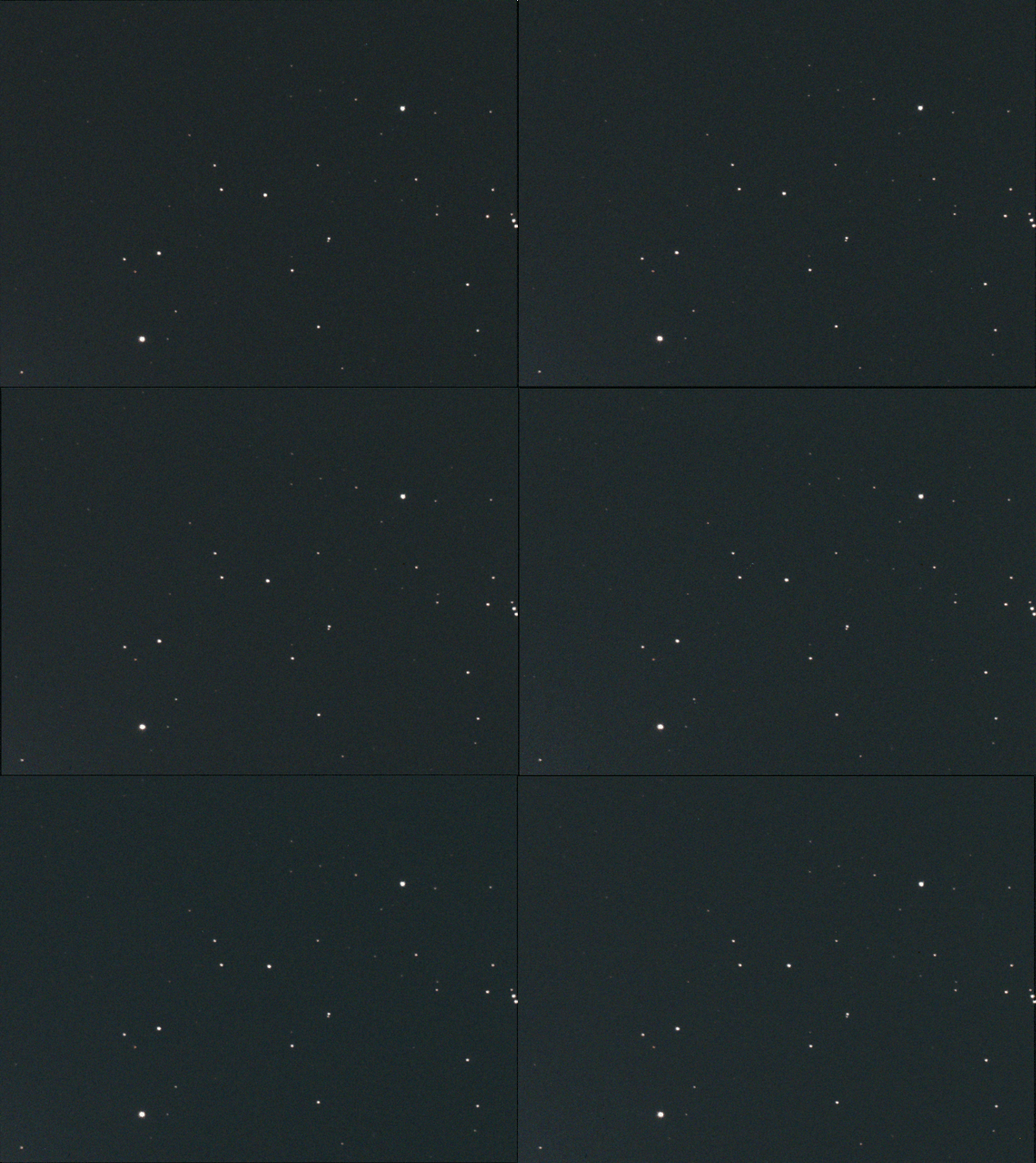
Two asteroids join the same field with Comet 67P/Churyumov-Gerasimenko on January 29, 2022. This animation is a screen capture of Astrometrica’s blinking tool. Field of view 20×15 arcminutes. North is up. East is left.[1]
Astrometrica picked up and identified asteroid 33651, also known as 1999 JG84, and asteroid 103516, also known as 2000 BY4.

Astrometrica detected these two small main belt asteroids barely above the noise level. There was just enough signal, however, to measure their magnitudes.  Asteroid 33651 was measured at magnitude 17.0 and asteroid 103516 as magnitude 17.3. JPL’s online Horizons System predicted magnitudes for 33651 as 17.3 and 103516 as 17.0. Comet 67P’s magnitude was measured as 12.5.

I was pretty surprised by the detections of these two asteroids. I image from a heavily light polluted backyard under Bortle 7-8 skies. These two objects were quite faint, and the images were only 30-second exposures.

Neither the JPL’s Small-Body Database, nor the Lowell Observatory’s Asteroid Information Database give sizes for these objects. But, both databases gave absolute magnitudes (H) for  them: 14.6 for asteroid 103516, and 13.5 for asteroid 33651. According to the JPL’s Asteroid Size Estimator, objects with these absolute magnitudes should have diameters in the range of 3-12 km (2-8 miles).

At the time of this imaging session, Asteroid 103516 was 174 million km (108 million miles) from Earth and asteroid 33651 was 263 million km (163 million miles) distant.

All things considered, I am amazed that my small backyard observing rig detected both of these tiny chunks of rock that were well beyond the orbit of Mars.

Notes:

1. January 29, 2022, 06:28:19-06:58:36 UT. Stack of three images, each a stack of 4 frames at 30 seconds (total 120s). Gain: 250. Telescope: Meade SN-8 (203mm f/4). Camera: ZWO ASI224MC with UV/IR cut filter. Mount: Celestron CGEM.

Dwarf planet Ceres, formerly asteroid 1 Ceres, was visible just before midnight on the evening of December 29th and into the early morning of December 30th. It was west of the celestial meridian, but still high in the sky at 57° at the start of the imaging session.  The seeing was fair-good.

Some of the images I captured of this dwarf planet follow. All were captured using a Meade LXD-75 SN-8 (203mm f/4) telescope and ZWO ASI224MC camera with UV/IR cut filter.

Dwarf planet Ceres on December 30, 2021, in the constellation Taurus at 05:54:26 and an hour later at 06:54:57 UT.  The field of view is 20×15 arcminutes.  North is up. East is left. Compare this image to a finder chart prepared with the Lowell Observatory’s Asteroid Finder Chart tool here.[1]
Ceres was traveling through the constellation Taurus at the time of this session, and at magnitude 7.9 appears quite bright against the background field of stars.  The very faintest stars visible in this 30-second image are magnitude 16.

Dwarf planet Ceres in motion against a background of fainter stars. Field of view is 20×15 arcminutes. North is up. East is left [2]
This animation puts Ceres in motion with respect to the background star field.  The animation is a 21-image time-lapse sequence covering 60 minutes. During this session, Ceres was moving across the sky at the rate of 0.33 arcseconds per minute, or 19.80 arcseconds per hour.

With a diameter of 964 km (600 miles), Ceres is the largest object in the asteroid belt between Mars and Jupiter. It is so large in fact, that it contains 25% of the asteroid belt’s total mass. Ceres’ large mass allowed gravity to pull it into a planet-like spherical shape, unlike most of its much smaller irregularly-shaped companions in the asteroid belt. Because of its shape, size, and mass, Ceres was reclassified as a dwarf planet in 2006. Although it is no longer classified as an asteroid, Ceres retains its official designation of 1 Ceres in scientific literature and databases.

Ceres orbits the Sun at an average distance of approximately 2.8 AU (413 million km/257 million miles). Ceres completes a lap around the Sun every 1,680 days, or once every 4.6 years. On the night of these observations, Ceres was 1.89 AU (283 million km/176 million miles) from Earth.  

Notes:

1.December 30, 2021, 05:54:26 and 06:54:57 UT. Stack of two images, each a stack of 6 frames at 30 seconds (total 180s). Gain: 320. Telescope: Meade SN-8 (203mm f/4). Camera: ZWO ASI224MC with UV/IR cut filter. Mount: Celestron CGEM.

2.December 30, 2021, 05:54:26-06:54:57UT. 60-minute, 21-image, animation sequence. Each image a stack of 6 frames at 30 seconds each (total 180 seconds). Gain: 320. Telescope: Meade SN-8 (203mm f/4). Camera: ZWO ASI224MC with UV/IR cut filter. Mount: Celestron CGEM.


Asteroid 145 Adeona was visible from my backyard observing location just before midnight on the evening of December 29th.  It was west of the celestial meridian already, but still high in the sky at an elevation of 64° at the start of the session. The seeing was fair-good.

Some of the images I captured of this minor planet follow. All were captured using a Meade LXD-75 SN-8 (203mm f/4) telescope and ZWO ASI224MC camera with UV/IR cut filter.

The images in this post can be compared to a finder chart prepared by the Lowell Observatory’s online AstFinder tool for this date and time. Open the finder chart in a new window by clicking here.

Wide View

Asteroid 145 Adeona on December 30, 2021, showing the asteroid’s movement against background stars in the constellation Taurus between 04:45:47-05:43:29 UT. Field of view is 20×15 arcminutes. North is up. East is left.[1]
On this night, 145 Adeona was traveling through the constellation Taurus. This part of the constellation does not present an especially rich star field for my 20×15 arcminute field of view. There were enough stars, however, to serve as comparison stars for measuring 145 Adeona’s magnitude.  Both the Minor Planet Center and NASA’s JPL Horizons System predicted magnitude 12.1. My measured magnitude in the V band was 12.35.

Wide View Animation

Asteroid 145 Adeona in motion against a background of distant stars. Field of view is 20×15 arcminutes. North is up. East is left [2]
This wide view animation puts 145 Adeona in motion across the sky. The animation is a 20-image time-lapse sequence covering 58 minutes. On this night, Adeona was moving across the sky at the rate of 0.30 arcseconds per minute, or 18 arcseconds per hour. 

Zoomed In Animation

This cropped and slightly enlarged portion of the wide view animation above gives a closer look at 145 Adeona as it moves across a not-so-rich field of background stars. The field of view is 14.5×10.3 arcminutes. North is up. East is left.

Asteroid 145 Adeona is a main belt asteroid with a diameter estimated between 120-150 km (75-93 miles). As a main belt asteroid, 145 Adeona orbits the Sun between the orbits of Mars and Jupiter. Therefore, it never presents a threat to Earth. Its orbital period is 4.37 years. At the time these images were captured, 145 Adeona was 1.6 AU (239,356,593 km/148,729,292 miles) from Earth. This is about as close as it ever gets to us.

Notes:

1. December 30, 2021, 04:45:47 and 05:43:29 UT. Stack of two images, each a stack of 6 frames at 30 seconds each (total 180s). Telescope: Meade SN-8 (203mm f/4). Camera: ZWO ASI224MC with UV/IR cut filter. Mount: Celestron CGEM.
2. December 30, 2021,04:45:47-05:43:29 UT. 58-minute, 20-image, animation sequence. Each image a stack of 6 frames at 30 seconds each (total 180 seconds). Telescope: Meade SN-8 (203mm f/4). Camera: ZWO ASI224MC with UV/IR cut filter. Mount: Celestron CGEM.