
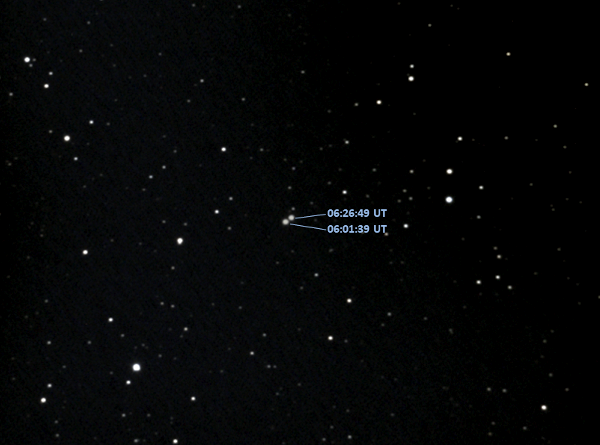
In the early morning of December 12th, just after midnight, asteroid 22 Kalliope was in the southeast sky, well positioned for imaging from my backyard. 22 Kalliope was inside the light dome of east Oklahoma City, but the seeing (i.e., the steadiness of the atmosphere) was good. Some of the images I captured of this minor planet follow. All were captured using a Meade SN-8 (203mm f/4) telescope and ZWO ASI224MC camera with UV/IR cut filter.
Wide View
Wide View Animation
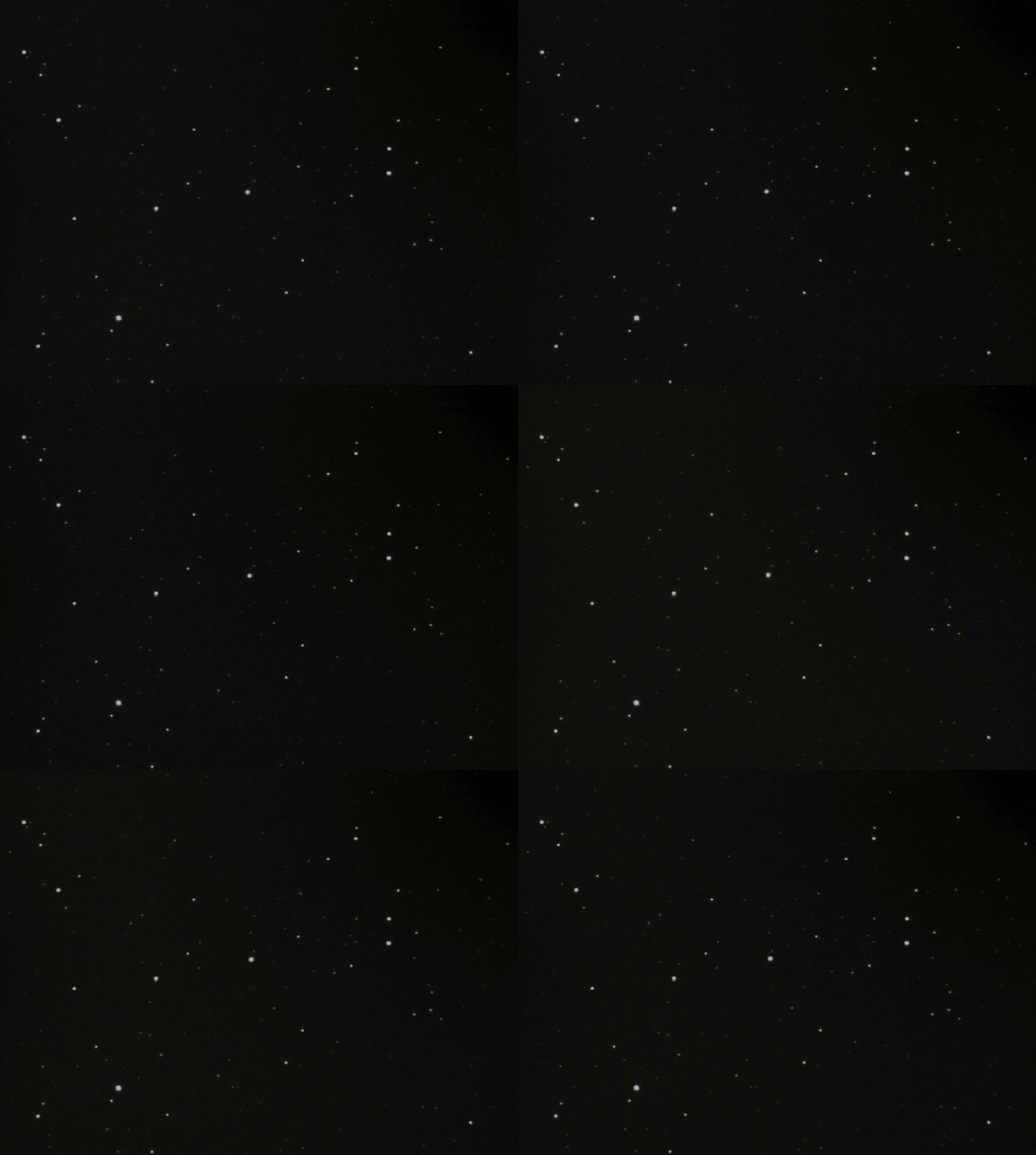
Zoomed In Animation

Asteroid 22 Kalliope is main belt asteroid with a diameter estimated as 168 km (104 miles). As a main belt asteroid, 22 Kalliope orbits the Sun between the orbits of Mars and Jupiter. Its orbital period is 4.96 years. At the time these images were captured, 22 Kalliope was 1.728 AU (258,505,100 km/160,627,600 miles) from Earth.
22 Kalliope doesn’t move through space alone. It is accompanied by a satellite asteroid named Linus. Linus is a good-sized asteroid in its own right with a diameter of 28 km (17 miles). Linus orbits 22 Kalliope at a distance of 1100 km (684 miles) with an orbital period of 3.6 days.[3]
Notes:
1. December 12, 2021, 06:01:39 and 06:26:49 UT. Stack of two images, each a stack of 10 frames at 30 seconds each (total 300s). Telescope: Meade SN-8 (203mm f/4). Camera: ZWO ASI224MC with UV/IR cut filter. Mount: Celestron CGEM.
2. December 12, 2021,06:01:39-06:26:49 UT. 25-minute, 6-image, animation sequence. Each image a stack of 10 frames at 30 seconds each (total 300 seconds). Telescope: Meade SN-8 (203mm f/4). Camera: ZWO ASI224MC with UV/IR cut filter. Mount: Celestron CGEM.
3. See, JPL Small-Body Database: 22 Kalliope, https://ssd.jpl.nasa.gov/tools/sbdb_lookup.html#/?sstr=22