I finally completed modifications to my Orion ST-80 (80 mm f/5) telescope and gave it a test run on the night of October 30th into the morning hours of October 31st. The modifications included replacing the original 1.25-inch focuser with a GSO 2-inch focuser, an Orion field flattener (to reduce field curvature distortion of star images), and a Baader Fringe Killer filter (to reduce violet-blue halos around the stars caused by chromatic aberration). The animation below shows asteroids (55) Pandora and (60) Echo, the targets for this first light test of the upgraded ST-80 paired with my ZWO ASI 482MC camera.
Asteroids (55) Pandora and (60) Echo in the constellation Pisces on October 31, 2023. This animation shows two hours of asteroid movement. (55) Pandora was at V magnitude 11.6 and moving at 0.17 arcseconds per minute (10.2 arseconds per hour). (60) Echo was at V magnitude 12.3 and moving at 0.20 arcseconds per minute (12.0 arcseconds per hour). IC 1496 and IC 1492 are distant background galaxies at V magnitudes of 15.5 and 15.2 respectively. Field of view 1.56° x 0.86°. North is Up. East is left.
I chose these targets because I wanted a field of view with two asteroids for visual interest, and I wanted to see how deep this telescope-camera combination scope could go. Conveniently, the field of view containing these two asteroids also contained two faint galaxies, IC 1492 and IC 1496.
The Minor Planet Center (MPC) predicted that (55) Pandora would be at Visual magnitude 11.6, and (60) Echo at 12.3. Both within easy reach of this scope-camera combo. The galaxies, however, were considerably fainter with IC 1492 at Vmag 15.2 and IC 1496 at Vmag 15.5. The galaxies would be the test of how deep this scope-camera combo could see. Additionally, I wanted to see how deep this scope-camera combo could go just using ten-second exposures.
The animation above shows the result. It consists of eight images taken over a two-hour period. Each image is made up of a stack of ninety 10-second sub images providing a total integration time per image of 900 seconds/15 minutes.
My hope in this project was to upgrade this inexpensive little scope to make it useable as a lightweight travel, EAA, outreach, and astrophotography telescope.
As I’ve previously posted, the Orion ST-80 is a simple achromatic refractor that trades off optical quality for very low price. One of these scopes sells now for $110 new.
Unfortunately, while very reasonably priced, as would be expected from an achromatic telescope, the scope suffers from severe chromatic aberration and field curvature. These two optical defects, common to achromats, cause noticeable violet-blue fringing around star images and distorted star images toward the outer edges of the field of view. Previous use of this scope showed that the field curvature was so bad that only about the central 30% of the field of view presented undistorted star images and the chromatic aberration produced large violet-blue halos around the stars across the entire field of view.
My plan to correct these issues was to insert an Orion Field Flattener and a Baader Fringe Killer filter in the optical path between the camera and the telescope. I had previously tested the Baader Fringe Killer and found that it did a good job eliminating the ugly violet-blue fringe halos around the stars. The field flattener, however, is new. But, because it is a two-inch accessory, I had to replace the ST-80’s original 1.25-inch focuser with a focuser having a two-inch draw tube.
Trying to complete this project on a limited budget, I chose the GSO 2-inch Crayford-style focuser from Agena Astro. With its two-inch threaded draw tube, the Orion Field Flattener screwed right on to the end of the focuser tube, and my ZWO ASI 482MC camera – with the 1.25-inch Fringe Killer filter screwed inside the camera just above the imaging chip – attached to the back of the field flattener with just the right spacing. As a bonus, this dual speed focuser provides for much finer focusing adjustments than the original focuser.
Looking at the images that produced the animation above, I am quite satisfied with the performance of this upgraded scope. The Baader Fringe Killer filter eliminated most of the violet-blue fringing around the stars, much of which disappeared anyway when I drastically lowered the color saturation to eliminate noise.
The Orion field flattener did a really good job of correcting field-curvature distorted star images across approximately 80% of the field of view. If you look close, you can see that the outer 10% on the right and left sides of the image contain slightly elongated stars. I could have cropped them out, or used one of the astronomy plugins for GIMP that have star rounding tools. But, in this case, other than some very slight cropping of the edges to remove stacking artifacts, I’ve opted to keep the full field-of-view image and not apply star-rounding correction.
Image Details October 31, 2023 04:04:12-06:04:00UT Two-hour time-lapse animation. Minor Planet Center Predicted Vmags: (55) Pandora 11.6; (60) Echo 12.3 8 images, each a stack of 90 @ 10 seconds. Gain 350 FOV: 93.8 x 51.5 arcmin/1.56° x 0.86° (cropped size for animation) North up. East left. Seeing: Poor Transparency: Good Sky Condition: Bortle 7 with nearly full Moon 70° to the East. Telescope: Orion ST-80 (80 mm f/5) + Orion Field Flattener + Baader Fringe Killer Filter Camera: ZWO ASI482MC Guide Scope: SVBONY SV165 (30 mm f/4) Mount: Celestron CGEM Captured with SharpCap Pro Processed with Deep Sky Stacker, GIMP Guiding: PHD2
I’ve only had one opportunity for asteroid imaging in the past six months, the most recent being on July 23rd. I’m finally getting around to posting the results of that session. Being somewhat rusty, I went for a relatively easy target, asteroid (234) Barbara.
(234) Barbara is a main-belt asteroid, and on the morning of July 23rd was at V magnitude 10.7. She was also moving along at a good clip for a main-belt asteroid at nearly 47 arcseconds per hour (0.78 arcseconds per minute).
Full image details follow below.
This is a slightly cropped full-frame image of (234) Barbara, with a field of view of approximately 30×18 arcminutes. The time-lapse animation covers approximately 1.5 hours.
This is a cropped and enlarged image with the finder chart from the Lowell Observatory’s online Asteroid Finder tool for comparison. The green circles on the finder chart show the asteroid’s projected movement at 30-minute intervals. The animation shows that (234) Barbara was right on course. The field of view is approximately 10×10 arcminutes.
Image Details Date/Time: July 23, 2023 05:08:42-06:41:17 UT Location: Edmond, Oklahoma USA Seeing: Fair; Transparency: Fair; Sky Brightness: Bortle 7 Length: 1.5 hour (98 minutes) time-lapse animation. Image Capture: 19 images, each a stack of 10 @ 30 seconds (total 300 sec per image). Gain 250. Orientation: North up. East left. Up is 1.3 degrees E of N Telescope: Celestron C8 (203mm SCT f/10) operating at f/5.8 (Celestron f/6.3 Focal Reducer/Flattener + 128.5 mm spacers) Camera: ZWO ASI482MC Capture: SharpCap Pro Guiding: PhD2 Processing: Deep Sky Stacker, GIMP Plate Solve: Astrometry.net
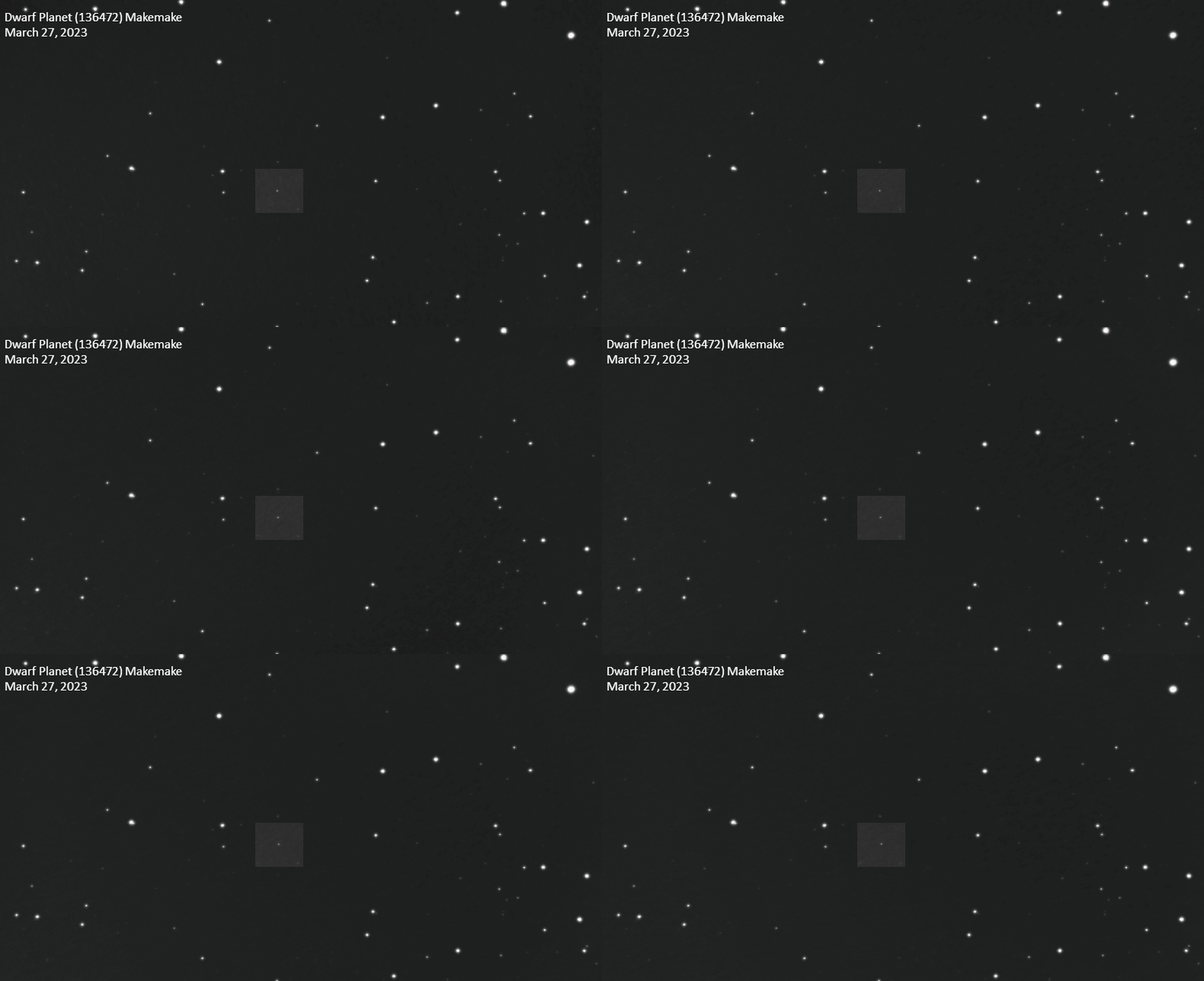
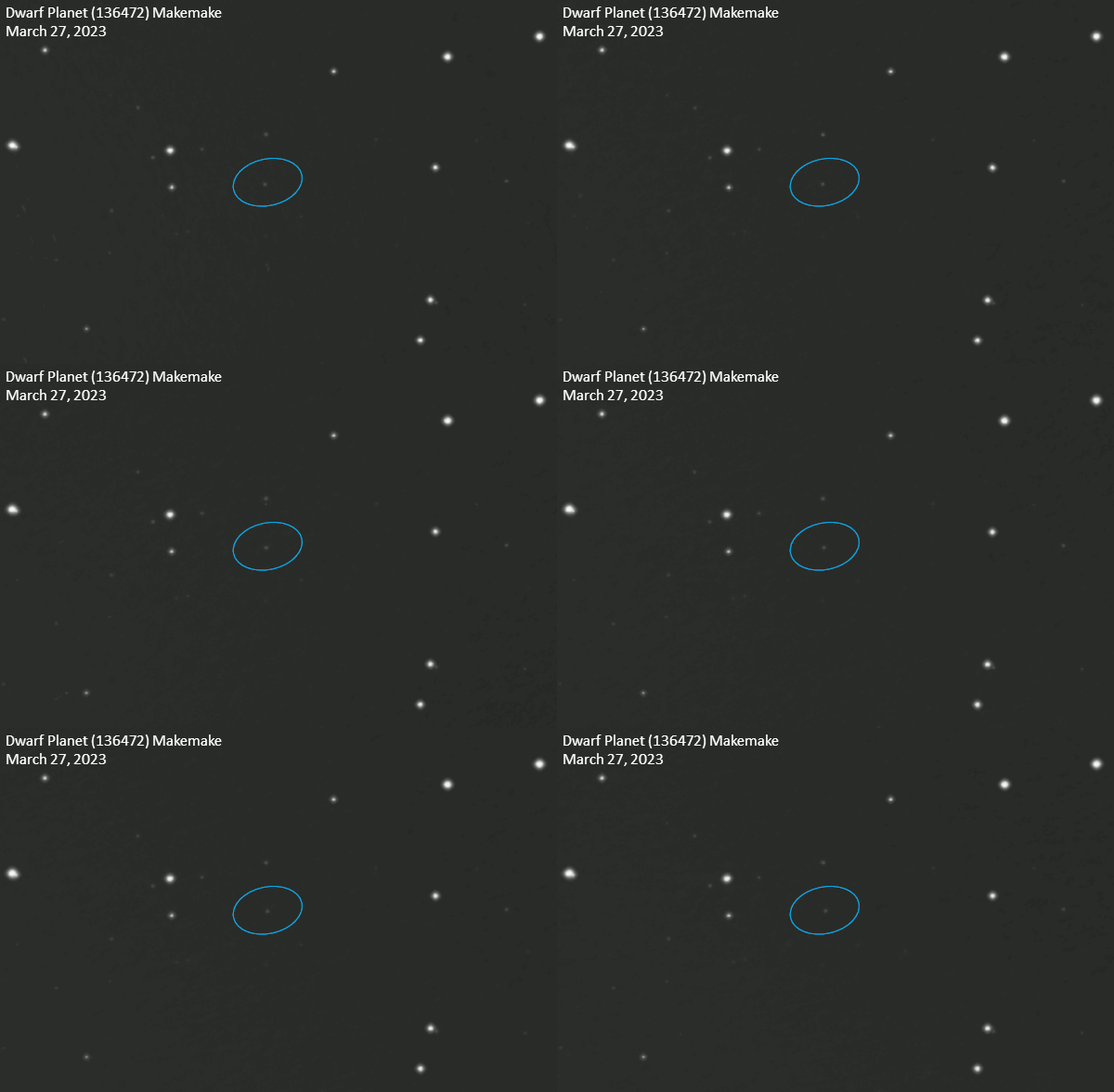
I made two attempts to catch dwarf planet (136472) Makemake in March. The first, in early March, was not so good, mostly the result of operator error and high thin clouds rolling across the field of view during the imaging run. During early spring here in central Oklahoma a night without clouds, high wind, and Moon is hard to come by so I wasn’t able to try again until March 27th with just two out of the three (no wind or clouds). I got better results this time out. The animations below capture just under three hours of Makemake’s movement. Image details are in the endnotes.
Dwarf planet (136472) Makemake on the night of March 27, 2023, as it moves slowly across a small patch of sky in the constellation Coma Berenices. The area inside the highlighted box was enhanced to make the faint Makemake appear brighter. This animation shows 2.75 hours of movement. Field of view 29 x 16 arcminutes. North is up. East is left. For a full-size image, click here. [1]
This cropped and enlarged animation zooms in on Makemake. In this animation, Makemake’s brightness has not been enhanced. The brightness as shown here is Makemake’s true brightness relative to the surrounding background stars. On this night, the Minor Planet Center predicted Makemake would be at V magnitude 17.10. My measurements put Makemake’s average V magnitude at 17.25. The brightest stars in this image are V magnitude 13. Field of view: 15×10 arcminutes. North is up East is left. For a better-sized view, click here. [2]The Session
On this night Makemake was in the constellation Coma Berenices moving at a snail’s pace of 0.042 arcseconds/minute. At this rate, over the course of the entire 2.75 hour imaging session, Makemake showed just under 7 arcseconds of movement.
The seeing and transparency during the session were pretty good. But, as usual, my backyard was awash in stray light from neighbors’ homes, nearby unshielded street lights, and a setting crescent Moon. And, as usual, I was looking out of my light-polluted Edmond location directly into the Oklahoma City light dome to the south. Under these conditions, I was half expecting not to be able to detect this faint object at all. But, after slewing the telescope to Makemake’s coordinates, and verifying that I was centered on the correct field, I was relieved to see Makemake’s dim pinpoint appear when the first image started building on the computer screen.
Imaging Considerations
Makemake’s slow sky motion was an important planning factor for this session. Makemake’s extreme distance from the Sun is the reason for its slow sky movement. Makemake orbits the Sun in the outer region of the Solar System known as the Kuiper Belt, a region inhabited by small icy bodies. Makemake’s average distance from the Sun is 4,253,000,000 miles (6,847,000,000 kilometers). This is nearly half a billion miles beyond Pluto. At this distance, it takes Makemake 305 Earth years to complete one orbit around the Sun. No wonder, as seen from Earth, Makemake is such a slow mover.
Because of its slow movement against the background stars, I had to plan to image Makemake for just under three hours to capture noticeable movement. Fortunately, at the time of this imaging session, Makemake’s sky motion was not at its slowest and I could plan on capturing its movement in a single-night session.
Many astro-imagers capture images of Makemeke on successive nights to show its movement against the background of stationary stars. This method avoids the tedious process of capturing hours-long image sequences on a single night, but produces a blinking depiction of Makemake’s movement rather than a smooth continuous movement. I prefer smooth continuous movement so I opted for the single-session approach, even though it shows less total movement.
Sky Motion: (136472) Makemake v. (2612) Kathryn
Object
Minimum
(arcsec/min)
Maximum
(arcsec/min)
Minimum
(arcsec/hour)
Maximum
(arcsec/hour)
(136472) Makemake
0.02
0.05
1.2
3.0
(2612) Kathryn
0.08
1.09
4.8
65.4
This table shows how much Makemake’s sky motion varies and how Makemake’s sky motion compares to asteroid (2612) Kathryn, a Main Belt asteroid orbiting the Sun billions of miles/kilometers closer in than Makemake. As this table shows, even at its fastest, Makemake only squeaks out a miniscule 3 areseconds per hour.
Another consideration in imaging Makemake is the fact that it is very faint for the relatively small 8-inch/203 mm telescope that I use. Because of its distance and relatively small size (diameter 900 miles/1500 km), Makemake is very faint as seen from Earth. For the date of this session, the Minor Planet Center predicted Makemake’s V magnitude as 17.10. I measured its magnitude on the first, middle, and last images of this animation sequence and obtained an average magnitude of 17.25, a bit fainter than predicted. At magnitude 17.25, Makemake is almost 5,000 times fainter than the faintest star a dark-adapted human eye can see from an very dark location.
Screenshot showing one of the three magnitude measurements taken of Makemake from images captured during this March 27, 2023, imaging session. The software used was the freeware program Astrometrica.
Polar Alignment Test
On a more technical note, this session was a trial run of using the freeware program NINA (Nighttime Imaging ‘N’ Astronomy) tool for polar aligning my Celestron CGEM mount during initial setup. Previously, I had been using Celestron’s All-Star Polar Alignment procedure (ASPA), a feature that allows a user to choose any bright star to polar align the telescope mount, not just one near the North Celestial Pole (NCP).
Like Celestron’s ASPA, NINA’s polar alignment routine does not require use of a star near the NCP. But, unlike ASPA, NINA does not require pointing at a specific star. For NINA, all that is necessary is to point the telescope at any star field anywhere in the sky with enough open sky for NINA to rotate the mount approximately 30 degrees on its right ascension/polar axis. The ability to polar align without being able to see the northern sky is important to me because the view of Polaris and the north circumpolar region is mostly blocked from my backyard by tall trees. The ability to polar align using any random patch of sky, not a specific star, was icing on the cake.
I won’t get into the details of NINA’s polar alignment process, but will say, that it was easier to use than Celestron’s ASPA because it did not require aligning the mount to the sky first, then slewing to and polar aligning on a specific star, and then performing another star alignment with a properly polar-aligned mount. NINA’s procedure allowed me to polar align first on a random patch of sky and then align the mount to the sky using Celestron’s automated StarSense alignment system. This arrangement, with the mount polar aligned first, saved much time in the star alignment process. Details on using NINA’s polar alignment tool can be found here.
In general, the results of NINA’s polar alignment function were pleasantly surprising. I found the tool quite easy to use, and fast. Probably the easiest and fastest method I’ve ever used for polar alignment. Far superior to the painful and time consuming drift alignment method, and easier and faster than SharpCap Pro and Polemaster.
The accuracy of NINA’s polar alignment also seemed quite good, although determining the accuracy is a bit of a trick. I stopped the alignment process when the NINA display showed I was aligned to within 37 arcseconds of the NCP. On this Celestron CGEM mount, stickiness of the azimuth and altitude knobs makes further refinements in polar alignment a time-consuming and often fruitless exercise. This remaining amount of polar alignment error is plenty good enough, and can be easily compensated for by the guiding software, PHD2 and my 50 mm SVBONY guidescope. Indeed, on this evening, my guiding error, as measured by PHD2, bounced around between 0.70-0.80 arcseconds, a very comfortable margin, well inside the 1.02 arcsecond/pixel scale of my telescope-camera system.
Polar alignment error of 37 arcseconds as measured by NINA after using NINA’s polar alignment tool. I could have attempted further alignment refinement, but opted to stop at 37 arcseconds.
Screenshot from Celestron’s CPWI program showing a polar alignment error of 2.4 arcminutes from this March 27, 2023, imaging session.Screenshot from PHD2 showing a polar alignment error of 2.4 arcminutes for this March 27, 2023, imaging session.
From these results, measured by three independent methods, it’s hard to say just how precisely my mount was polar aligned. At best, it was within 37 arcseconds of the north celestial pole. At worst, it was within 2.4 arcminutes (144 arcseconds). But, even at its worst, this single instance is an improvement over what I was getting using the Celestron ASPA process. Polar aligning with Celestron’s ASPA procedure and measuring the error with Celestron’s CPWI and PHD2 showed that I was typically getting between 2.5-5.0 arcminute polar alignment error. Only more experience and data points will tell if NINA consistently provides better polar alignment. I will continue to gather more data.
Conclusion
Overall, this was a productive imaging session. I am now confident that my rig can detect 17th magnitude point source objects from my light-polluted Bortle 7 backyard. I’m looking forward to pushing the limits further by imaging dwarf planet Haumea, a slightly fainter Kuiper Belt neighbor of Makemake. I am also pleased with NINA’s polar alignment tool. So much so, that even if its precision is no better than Celestron’s All-Star Polar Alignment process, I will continue using it for its ease of use and considerable time savings in setting up for an imaging session.
Image Details:
1. Date/Time: March 27, 2023 04:29:02-07:12:33 UT Location: Edmond, Oklahoma USA Seeing: Fair-Good; Transparency: Poor; Sky Brightness: Bortle 7 2.75-hour time lapse animation. 9 images, each a stack of 20 @ 60 seconds (total 1200 sec per image). Gain 250. Orientation: North up. East left. Up is 1.4 degrees E of N FOV: 28.6 x 15.6 arcmin FOV Center: 13h 17m 43.931s +22° 25′ 18.387″ Telescope: Celestron C8 (203mm SCT f/10) operating at f/5.8 (Celestron f/6.3 Focal Reducer/Flattener + 128.5 mm spacers) Camera: ZWO ASI482MC Capture: SharpCap Pro Guiding: PhD2 Processing: Deep Sky Stacker, GIMP Photometry: Astrometrica
2. Same as above except: FOV: 15.3 x 9.99 arcmin (cropped/resized animation) FOV Center: 13h 17m 47.309s +22° 24′ 05.224″